Senior HR leaders identify the role of leadership as the primary lever shaping 2026 priorities. The Cedar HR survey results demonstrate the strong correlation of the role of leadership with performance accountability.
Ask senior HR leaders what will define their 2026 priorities, and one response stands out well ahead of others.
In Cedar’s 2026 HR Pulse Survey, 60 percent of the respondents selected the role of leadership in unlocking human capital as a top priority, ten points clear of anything else on a list of ten human capital levers. This instinct aligns with thirty years of evidence: over twenty percent of organizations successfully convert strategy into outcome, while challenges are in execution.
Translating sound instinct into a practical mechanism remains essential. Strategy succeeds when ambition transforms into measurement, connecting enterprise decisions directly to daily workplace actions. The survey reveals HR leaders selecting the foundational elements of this chain with conviction while identifying growth potential.
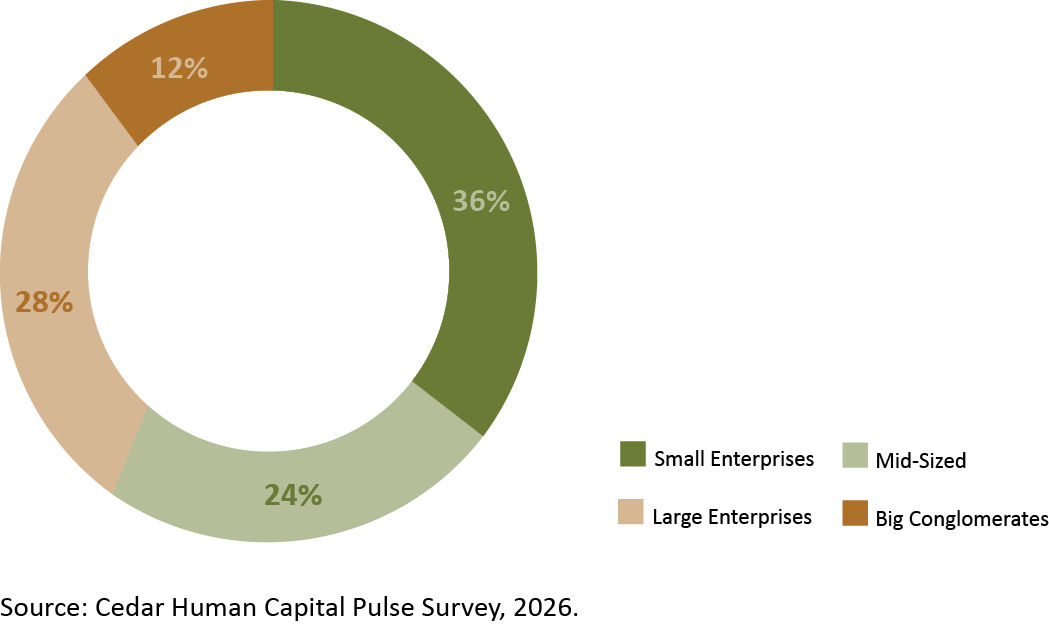
Cedar surveyed 124 senior HR professionals across a global organizational cross-section, asking them to score ten human capital levers based on their respective organizations’ priorities in 2026. These levers cover the role of leadership, culture, structure, KPIs, reward, capabilities, L&D, talent, and AI adoption. Respondents represent diverse organizational scales, led by small and mid-market firms alongside large enterprises and conglomerates.
ROLE OF LEADERSHIP TO UNLOCK HUMAN CAPITAL | CORE PRIORITY
The concentration at the top provides significant insight into organizational priorities. Ten points separate the role of leadership from everything beneath it, after which the differences narrow sharply. KPI clarity at 46 percent, pay-forperformance and the right structure at 43 percent each, and a climate for action at 40 percent, placing the four levers inside a six-point band. Respondents evaluate the operational levers with comparable weight. Organizations view the role of leadership in unlocking human capital as the single most critical lever, prioritizing it far above all other options.
The phrase ‘leadership matters’ is routinely heard as a claim that organizations need more leaders. In practice, it means something far more specific. Leaders activate potential in team members, directly driving enterprise value within a human capital strategy. Effective leaders articulate enterprise vision and align that ambition with daily responsibilities. Organizations gain immense value when leaders combine dedicated effort with absolute clarity
ORGANIZATIONAL FRAMEWORK AND PERFORMANCE ACCOUNTABILITY: STRATEGIC FOCUS ADAPTS WITH SCALE
The levers group into two natural halves. Role of leadership, right structure, rightsized organization, and AI-driven capability form the organizational framework, representing the design choices that shape how the enterprise operates. HR meeting financial objectives, KPI clarity, pay for performance, and a climate for action form the performance accountability half, functioning as the mechanisms that connect direction to results. Each half supports the other. The role of leadership sets the model, structure holds it up, sizing optimizes scale, and AI equips operations. Financial alignment sets the goal, KPIs make progress visible, pay attaches value to achievement, and climate carries the effort forward. Across organization sizes, these two halves show a clear and consistent alignment pattern.
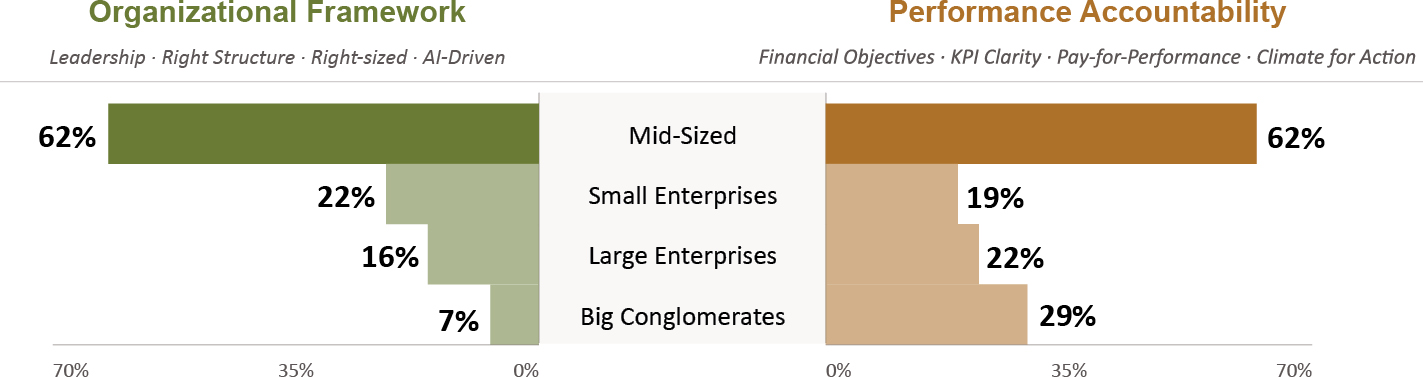
Mid-sized organizations rate both halves identically (62%), while small enterprises maintain balanced orientation across both. Large enterprises and conglomerates lean heavily into performance execution, with conglomerates registering 7 percent on framework and 29 percent on accountability.
This progression matches organizational scale. Mid-sized firms operate with team proximity, giving framework and accountability equal weight. As enterprises expand, foundational design choices establish a steady baseline, allowing formal accountability systems to perform primary operational delivery across large-scale operations.
THE TEN HUMAN CAPITAL LEVERS: PRIORITY CONVICTION VS. SUPPORTING FOCUS
Respondents evaluated each human capital lever by its priority and conviction level for their respective organizations in 2026. The resulting framework maps these levers across two distinct dimensions: Top Priority, representing the percentage of respondents who identified a lever as a top-two focus area, and Next-Level Priority, capturing those who designated it as an important supporting focus.
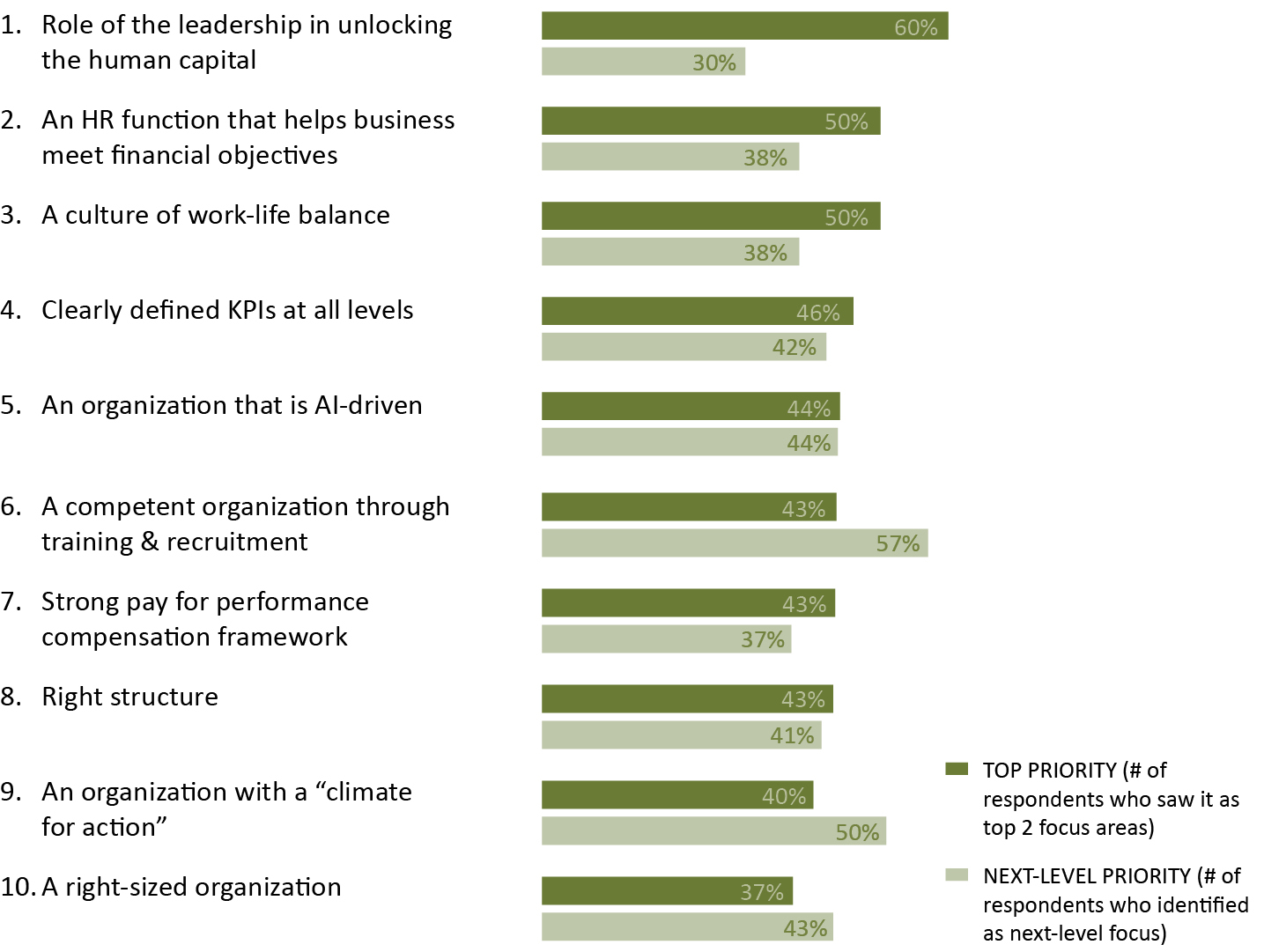
The relationship between top-priority conviction and next-level attention highlights a distinct role for each lever. Training and recruitment, climate for action, and right-sizing command broad next-level engagement as foundational capabilities, while AI-driven organization balances equally across both dimensions. The role of leadership stands out as the single decisive priority, setting the direction while surrounding levers provide the operational machinery to deliver on it.
FROM CONVICTION TO CASCADE
The Balanced Scorecard (BSC) helps align the leadership vision with the organization framework, driving performance accountability. It translates enterprise objectives across four key perspectives: financial, customer, internal processes, and learning and growth. It also helps cascade these perspectives directly into targeted performance metrics that connect across organizational levels. When human capital initiatives operate without direct links to enterprise value, structural gaps are inevitable.
Leading organizations distinguish themselves by operationalizing leadership principles into clear execution paths. Sustainable success belongs to institutions establishing structured lines of sight where strategic direction connects to defined metrics and individual objectives on a single framework, turning priority declarations into enduring operational systems.
Cedar’s proprietary BSC Accelerator and PeopleBSC tools drive this strategic alignment, drawing on a library of over 2,000 lead and lag metrics to provide every team member with a direct line of sight to enterprise goals. Cedar’s approach aligns enterprise strategy with individual performance measures. Cedar helps its clients build organizational structure designs, competency frameworks, job description alignment, and aligned focus areas including talent development, succession planning, and headcount optimization.
Human capital is pivotal to make strategy work.
Drawn from the Cedar 2026 HR Pulse Survey (senior HR professionals across a global cross-section of organizations, rating ten human capital levers on a five-point scale; self-selected sample). Figures are directional and intended to inform leadership discussion rather than serve as definitive conclusions.