

Often the governing committees, managing a technology transformation as large as a core banking transformation, require a holistic view of the current state and readiness to initiate the upcoming major or milestone for the right decision making. RAPID framework – a Cedar proprietary tool is a practical framework which comes handy
Technology transformation is very easily mistaken to be about system/application readiness alone. Hence, while a financial institution is undergoing a core banking transformation, all the focus is shifted towards system readiness. Before initiating a new milestone, frequently, system readiness becomes the only parameter to assess readiness. Therefore, the decision making behind initiating a new milestone is made on a hollow foundation. This results in ineffective program execution and most importantly, completion.
Drawing the experience from 40+ core banking implementations, Cedar recommends the RAPID framework, which gives a holistic view in assessing readiness for program milestone initiation or completion. RAPID abbreviates to the five essential components or perspectives of technology transformation which becomes necessary for consideration - Resources, Application, Process, Infrastructure and Data. Following is an image explaining the RAPID Framework
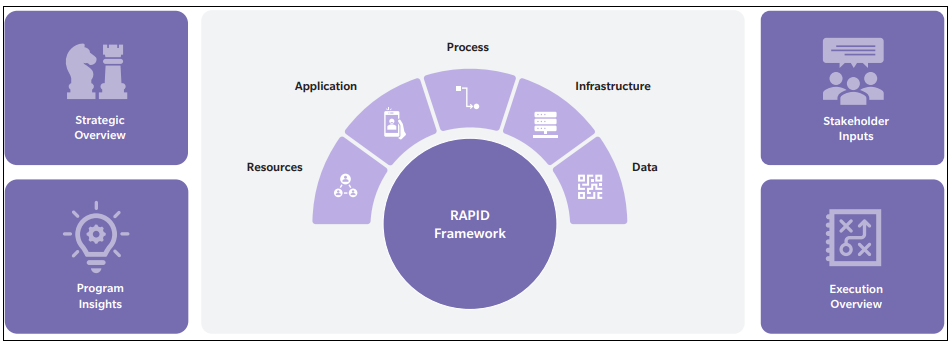
RAPID Framework Utility
The RAPID framework could be very effective in assessing readiness for an upcoming milestone at multiple levels, including the Board / Steering Committee, Working Committee and Program Management Office (PMO). Below is a 3-step approach to using the RAPID Framework.
Step-1 | Strategic
As an example, let us consider that the upcoming major milestone is the initiation of User Acceptance Testing (UAT).
Following are some of the sample questions that governing bodies of core banking transformation such as PMO should ask at a strategic level.
- Resources: Are the right resources, sufficiently allocated as part of the testing workstream?
- Application: Has the system met all its entry criteria for initiating the UAT?
- Processes: Has the UAT Strategy been drafted and accepted by all the stakeholders?
- Infrastructure: Are surround systems required for UAT made available?
- Data: Is the necessary data for UAT migrated and validated?
Step-2 | Operational
To answer the questions defined at Level-1, it is vital to further sub divide individual components of RAPID to 2-3 assessable parameters. Following is an example
- Resources (Are the right resources, sufficiently allocated as part of the testing workstream?)
- Representatives allocated from 15 of 15 business units
- At least 2 members allocated from each of 15 business units
- Application (Has the system met all its entry criteria for initiating the UAT?)
- Has the System Integration Testing met all its exit criteria
- Has the test cases required for UAT been submitted, verified and signed-off
- Processes (Has the UAT Strategy been drafted and accepted by all the stakeholders?)
- Have all 15 business unit leads reviewed UAT strategy document
- Is the document incorporated with all the inputs and signed off
- Has the briefing session for UAT testing conducted for testing and incidents management
- Infrastructure (Are surround systems required for UAT made available?)
- Is all the 30+ surround systems integrated with the core banking solution
- Is the URL for the UAT Environment made available and communicated
- Is the associated development environment for incidents managements made available
- Data (Is the necessary data for UAT migrated and validated?)
- Is the data migration round before UAT been completed and validated
- Has all the high priority issues in the data migration been resolved
- Has the migrated data been loaded into the UAT Environment
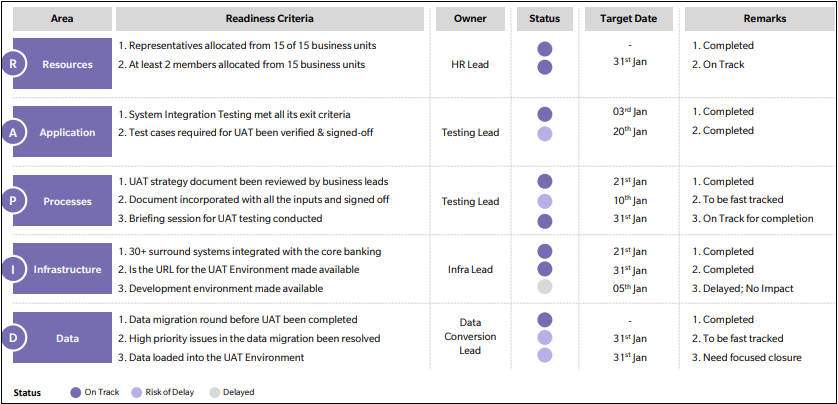
Step-3 | Assessment
The parameters defined at Step-2, it is important to assign an owner, target date and the RAG status. With this, each of the parameters is also successfully converted into an actionable with ownership assigned. The RAG status would indicate if we are on track to achieve the action/parameter. (Red: Delayed, Amber: Risk of Delay, Green: On Track/Completed). Following is illustrative of how a developed RAPID Framework would look like
Further, it is essential to follow the steps defined as it servers multiple purposes. Firstly, it provides the initial clarity required to understand the milestone’s objectives from a holistic view. With this clarity, the parameters could be easily defined.
Secondly, it forms a base for structured representation at the steering committee or the working committee simplifying the decision making process.
Conclusion
It is important to note that the RAPID Framework could be applied at any juncture of the program execution to assess a milestone initiation/ completion readiness including requirement gathering, testing, data migration, business simulation and go-live. However, the questions asked at Step-1 and parameters defined at Step-2 would change accordingly