

A few years back, banks considered their IT units as enablers. With many factors, including rapid digital adoption and shifting customer expectations, influencing the way banks operate, things have drastically changed. Today, a bank is what its IT is
The digital & IT capabilities of a bank forms the base to what it can offer to its customers. It is prevalent for a bank these days to feel that its business has overgrown its IT capabilities. This is not a good feeling for the bank’s growth. This is the exact juncture where a bank feels that its IT capabilities must be revisited and reviewed. However, it is essential to note that building IT capabilities and the IT strategy should always take a top-down approach. In other words, one cannot look at a specific issue or an incident separately and try to fix it on an issue-by-issue basis. The IT function of the bank must be looked at from a holistic perspective.
The guiding factors include the bank’s vision and mission, business strategy, business drivers, and other leadership team guidance supplemented by customer feedback or the voices of customers.
Below is the survey response received by banks as part of their customer feedback and voice of customer engagements.
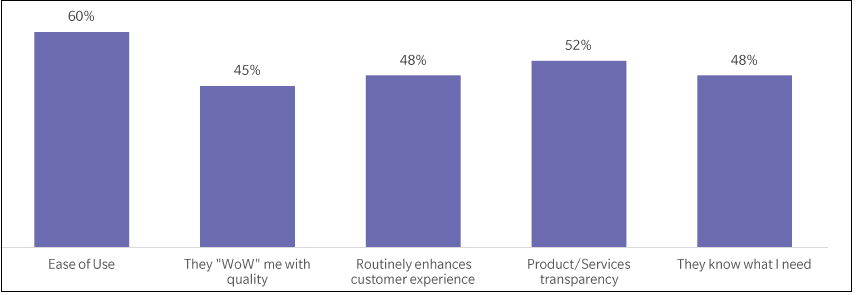
In summary, this indicates the need for a bank to constantly relook at its digital and IT capabilities and incorporate customer feedback.
Previously, banks’ IT strategy was revisited once every five years. However, times have changed. Banks have realised the importance of reviewing their IT Strategy once every two years and aligning their IT Strategy to their business strategy and drivers. A team that is building the IT Strategy for the bank needs to ask the following questions.
- Where Are We Heading? (The Business Strategy, Drivers)
- Where Are We Today? (Current State Assessment)
- So What? (Way Forward)
- When do We Act? (Roadmap)
The above four questions form the 4-step approach to building an effective digital and IT strategy and cover some of the critical considerations for banks to keep in mind.
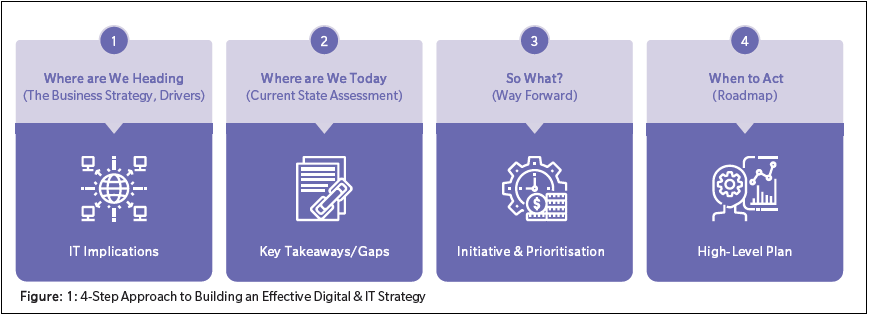
Where are We Heading (The Business Strategy, Drivers)
The growth of IT, for all the right reasons, cannot be built in silos. For the team, which is building an IT Strategy, it becomes extremely critical to understand the bank’s business strategy. More importantly, the implication of business strategy on IT functions. The IT implications could be logically separated into three key areas – Applications, Technology & Organisation, for simplicity and better structure:
- Application | covers the application landscape, including digital services.
- Technology | covers the hardware and network infrastructure.
- Organisation | covers the people aspect of IT.
Where are We Today (Current State Assessment)
Within the bank’s business strategy, it is essential to know its current state. This would require a detailed study of the existing capabilities across the three areas of Application, Technology and Organisation. At this juncture, it becomes critical for the team that is building the IT Strategy to ask a very pertinent question: “Is ‘Where we are today’ going to take us to where the bank wants to be?”. Answering this question would lead one to one or more gaps that require to be filled. Identifying and, most importantly, acknowledging these gaps forms the base to the next step.
So What? (Way Forward)
With an understanding of the implications of the business strategy on IT and the gaps identified with the current state assessment, one should know how to fill the gaps. In other words, these are the directions for the way forward. However, completing Steps01 and 02 would only lead the team building the IT strategy in the right direction. To conclude Step 03 successfully, the following needs to be considered:
Identifying the Initiatives: Based on the directions, identify the key initiatives (actionable) across Application, Technology & Organisation. A key consideration here is to have all the initiatives identified and the prerequisites, supplementary and complementary actions to be recognised as individual initiatives. Each initiative must be associated with accountability or an action owner to be executed in a timely fashion. By the end of this activity, the bank will end up with a long list of initiatives to be taken up to align the IT strategy with the business strategy.
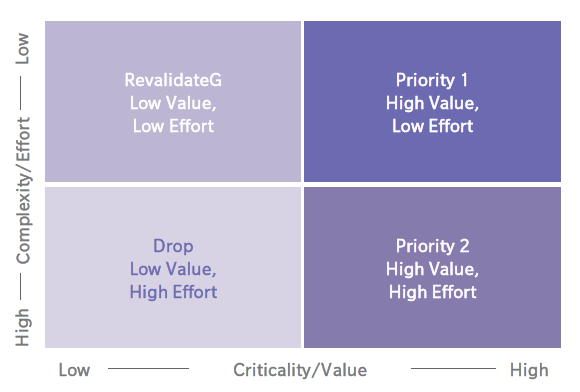
Prioritising the Initiatives: It is not practical for a bank to undertake all the initiatives identified at one go. The key here is to group them into logical categories for the initiatives to be taken up immediately (short-term initiatives) and initiatives to be taken up later (medium- and long-term initiatives). The short-term initiatives are typically those that have to be activated and closed in the next six months. The medium- and long-term initiatives are the ones that have to be taken up in the next 1-1.5 years. While the number of categories can go anywhere between three or four, the critical aspect is to appropriately identify what initiative would fall into each category. Below is a diagrammatic representation to simplify the prioritisation process.
When to Act (Roadmap)
A roadmap is a high-level plan. However, a roadmap is not a replacement for an implementation plan. A roadmap would guide the team on how to prepare to implement the initiative. The high-level timelines would lead the team towards factors and dependencies such as approvals from the leadership team, budgets, resources, procuring systems from a supplier, planning for support and maintenance.
Key Considerations
With the business strategy leading to IT implications, current state assessment leading to some of the key gaps, the way forward leading to a long list of initiatives along with the prioritisation and finally the roadmap, the 4-step approach is an effective way to build an IT Strategy. It is imperative that these four steps are executed sequentially as the output from the first step would form the next step’s input.
Cedar brings significant experience from the industry to build and implement such a digital & IT strategy for global financial institutions.
Based on our experience, the following are some of the key considerations for banks to keep in mind while building their digital and IT strategy.
Business Strategy Awareness: In many banks, the IT team members have not been oriented about the business strategy. This means that an IT staff member is not aligned with the bank’s goals and strategy, and the decisions made by such staff members are not aligned with the business priorities at all. This could be detrimental not just while building an IT strategy but at any given point in time.
Resistance to Change: Often, the team on the ground and sometimes even the senior management exhibit resistance to change. A bank needs to build an IT strategy as a growth initiative for the bank rather than just a change management initiative.
Peer Comparison: What has worked for one bank may not necessarily give another bank the same positive result. Hence, a peer bank’s success story can only be looked at from a learning perspective and not from a replication perspective. Undergoing the journey of the 4-step approach is a must, and any shortcuts may not necessarily lead toward positive results.
Top-Down vs Bottom-Up: The holistic approach towards building a digital and IT strategy can only be seen when the whole exercise is approached from a top-down perspective rather than bottom-up. The disadvantages of the bottom-up approach, in this case, are many and would include oversight, siloed view/perspective and short-term rather than long-term resolutions.
Inside-out vs Outside in: Inside-out is within the bank perspective, whereas outside-in is the industry perspective. The outside-in perspective is critical while building an IT strategy. It provides the bank with the opportunity to consider all the key learnings and the global and regional industry practices while building a digital and IT strategy of its own. However, it must be viewed from a learnings perspective only and not from a replication standpoint.