

What are you selling?
“Never let a good crisis go to waste”, is a popular quote attributed to Winston Churchill. While these words were probably uttered in the aftermath of the Second World War, they still hold true in the 21st Century business world. Businesses are so often caught up in the daily scramble for growth and survival, there is little time to reflect on the bigger questions. Few industries face as much pressure to adapt as the Retail industry. Shifting customer footfall, volatile supply chains and changing buying habits have forced retailers to rethink how they operate. Periods of disruption are difficult for most businesses, but they also provide an opportunity to pause and contemplate the basics.
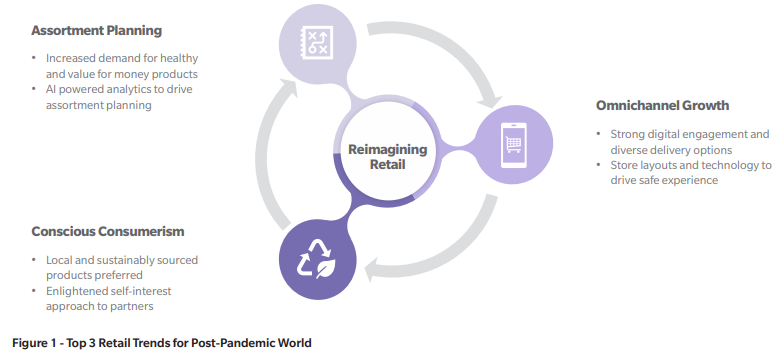
Ask a retailer ‘what are you selling?’ and their answer to that basic question will give you a deep insight into their mindset. Is it a product or service? An experience? A lifestyle? A sense of belonging (can you sell that!)? As retailers are grappling with existential challenges, we look at the top 3 trends that are going to shape the future of the retail industry.
1. What’s in the basket?
Assortment planning is the process of ensuring that the right selection of products is available at the right time and in the right store. As a first step, capturing and analyzing data at a granular level becomes important. Understanding the performance of categories, and brands within categories provides a good basis to manage assortments. Using AI-powered analytics, retailers are able to more scientifically and accurately predict the assortments required. This drives better stock movement, product sales and cash flow management. While retailers account for seasonal trends and fluctuations, deeper shifts in consumer behaviour are driving longer term change that will impact assortment planning. Changes in the way we live and the way we make our livelihoods are reshaping consumer behaviour in a couple of crucial ways.
The first is health. Consumers have developed a greater awareness with regards to what they put in their bodies, and the affinity towards healthy products has increased. Social media is awash with fitness challenges, home workout routines, and healthy recipes. These trends are here to stay, and retailers would do well to give enough importance to the health category going forward.
The second is value. Economic uncertainty affects peoples’ livelihoods and their confidence in their economic future. This has given rise to a greater emphasis on value for money. Private label and value brands are likely to see greater traction than cutting edge, premium products. As the uncertainty around the economy drags on retailers need to think about their portfolio mix to ensure they remain in good economic health.
2. All together
Local sourcing, ecosystem development and supplier upliftment have been terms in vogue for many years. These concepts were driven more by the idea of ‘enlightened self-interest’ on the part of businesses, than a really serious push by consumers. An important recent shift has been the acceleration of the conscious consumerism trend. Consumers are paying closer attention to local issues. The community and its associated linkages became clearer to consumers, and their importance inescapable. Purchase decisions are not simply restricted to what to buy, but equally driven by who to buy it from. This has given businesses the opportunity to differentiate themselves from the competition by highlighting their virtuous persona. Millennials and Gen Z’s, in particular, place a greater premium on these qualities in the brands they like to associate themselves with. Consumers are more eager to be associated with such brands, creating a virtuous cycle!
Fabindia, an Indian retailer of apparels and home décor, follows a community-based sourcing & supplier ecosystem development program to drive sustainable growth. It has created 17 Supplier Region Companies (SRC) that have a minimum 26% stake reserved for artisans, with FabIndia owning 49%, and employees & investors owning the rest. During periods of disruption, they have sped up their vendor payments to those vendors that had a high dependency on income from Fabindia. Despite operating in a crowded and largely unorganized Retail sector in India, Fabindia has maintained strong financials and a growth outlook. Another interesting example is ‘The Honest Company’, an American consumer goods company launched in 2012 by the Hollywood actress Jessica Alba. Driven by the concept of ‘ethical consumerism’, it focuses on sustainable sourcing and transparency, and now has a valuation of over a Billion dollars.
3. Wherever you go
Providing customers with an omnichannel experience was fast becoming an important tool in any retailers’ arsenal. It has now become table stakes for conducting retail business at any meaningful scale. The idea is to combine the convenience of shopping online with the experience of visiting a physical store. However, transferring the store experience and all the engagement that it entails has been challenging for retailers. Virtual engagement and personalized experiences are bridging this gap. Taobao Live, a live streaming platform on Alibaba Group’s Taobao marketplace, allows the staff of merchants and social media influencers to create content that engages customers and promotes their products. This platform helped increase sales by over 400% in October 2020, during their annual shopping festival. Another key component to delivering a successful omnichannel experience is diversifying delivery options. Customers are embracing options such as ‘click and collect’ and ‘curbside pickups’ that offers convenience and speed.
It is important to remember that omnichannel also includes physical stores as well. As retailers invest in their stores, safety (for customers and employees) remains a key consideration. Safety is considered a basic need in Maslow’s Hierarchy of Needs, placed above only Physiological (food, water, clothing, etc.) needs in the pyramid. While retailers were always a source for the latter, it has now become imperative that they closely look at providing the former – at least within their stores! This means store layouts that manage crowding, with clear signage and safety devices. It will also require investments in technology to promote contactless payment and high hygiene standards in common areas within the store. Stores such as Sainsbury’s and Woolworths have trialed virtual queuing systems and reservation of shopping times to enable customers to skip queues and avoid crowds. Providing a safe and secure environment for customers will be a major element in driving a positive customer experience in stores.
More of the same?
With so much upheaval and a constant state of change, sometimes it is better to focus on what is not going to change. Customers will always value availability of their preferred products, at a fair price, delivered in a safe and convenient manner. Keeping the customer as their North Star, retailers need to adopt new practices and adapt to the changing consumer behaviour. Disruption has forced retailers to reassess old ways of operating and embrace new models that are likely to persist for years to come.