

What if they stay?
The clock in her study ticked over to 8pm, as the CEO of a mid-sized technology company tried to refocus on the Zoom call. Her CFO was projecting the quarterly numbers on the screen, and it did not make for pleasant reading. While they had been disciplined with reigning in expenditure across most areas as market conditions tightened, the most significant, employee expenses, was still to be fully mastered. Who to let go? What competencies were critical to the firm? Which competencies needed to be developed? She was adamant that re-skilling the employees was a crucial investment that had to be made. The CFO shot back at her, “What if we train our employees, and they leave?”. Keeping the edge out of her voice, she replied, “What if we don’t train them, and they stay?”
The conversation at this fictional company is one that is happening across offices (or video calls, as the case may be) in all parts of the world. Economic disruption has forced many companies to make difficult decisions to simply keep their head above the water. The old ways of working have become redundant to a large degree and adapting to the ways of the new world is quite simply a matter of survival. Companies can only adapt if their employees adapt. It becomes incumbent on organizations to ensure that the right competencies are being measured and developed within the organization. This is where most organizations let themselves down by focusing only on outcomes and not the foundations that drive these outcomes.
A Competency Assessment Framework can drive desired behaviour & reinforce organization values. It is used by organizations to communicate which behaviours are required, valued, recognized and rewarded for specific levels. This is typically applied across management levels and can be leveraged for recruitment, promotion and training needs analysis. It provides a framework that organizations can leverage to drive feedback and development plans for employees. Applied intelligently, this is a powerful framework that can guide organizations in building an organization that can survive and thrive during these uncertain times.
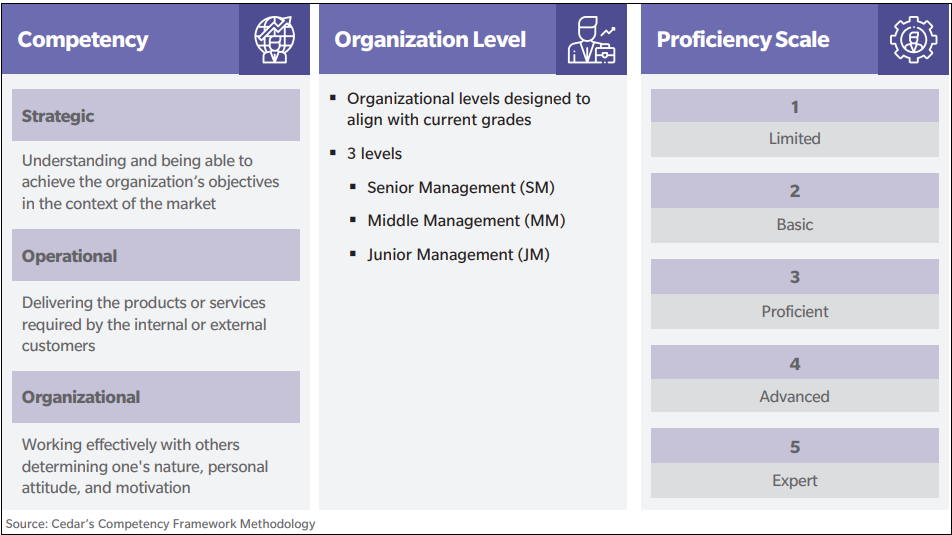
Cedar’s Competency Framework provides organizations a structured method to measure and develop appropriate competencies. It comprises of 3 major competency clusters (Strategic, Operational and Organizational) that are typically classified into 3-4 competencies within each. These are applied across management levels and are scored on a proficiency scale ranging from 1 (Basic) to 5 (Expert). The definition of each competency across levels will differ. For example, a senior management employee scoring a 4 on a strategic competency such as ‘Data-driven decision making’ would have ‘Highly developed understanding of data-driven research, with strong ability to leverage data in decision making’. Whereas a junior management employee scoring a 4 on the same parameter would have ‘Highly developed application of data analysis and strong ability in gathering, analyzing and presenting data to managers’. This provides a more precise definition of competencies across levels.
Strategic | Oh Captain, my virtual Captain!
Strategic competencies are a measure of the employees’ ability to achieve the organizational objectives within the larger economic context. Can they link long term goals and the big picture while working on daily tasks? Leverage available technology to take scientific decisions? Identify industry trends and seek out market opportunities? Drive decisions that are based on data rather than anecdotes? These are competencies that are tried and true across industries and economic scenarios.
In today’s world, newer strategic competencies will be far more significant to develop within organizations. Critical thinking & adaptability to a volatile environment are essential strategic competencies to survive. Leadership will remain an important competency – but with a twist. Leadership ability does not simply imply leading others. A crucial part of leadership is the ability to lead yourself, be a self-starter. With hybrid and remote working now commonplace, autonomous decision making is a prized competency. Leadership in general, will need to be adapted to virtual leadership – the ability to inspire and guide remotely.
Operational | Do what you do, do well
Operational competencies are those set of competencies that enable employees to deliver products or services required by internal or external customers. Do they have the requisite knowledge and technical skills to deliver their daily tasks at the defined quality? Focus on execution and implementation of ideas? Maintain operational efficiency ensuring compliance on Quality, Time and Cost (QTC) parameters? These are some of the essential competencies for an employee to fulfil their daily duties.
While certain competencies will remain constant across industries and scenarios (such as QTC compliance), a more nuanced and industry specific approach is necessary due to rapid shifts in markets and customer behaviour. Shift in business models, such as a Retailer moving more towards online would require the relevant competencies to be developed or brought in. In the Financial services industry, for example, in-person/ in-branch sales have taken a hammering that they are unlikely to recover from. This would make virtual selling an important tool in any Relationship Managers’ arsenal.
Organizational | Human touch in a digital world
Organizational competencies are a measure of the employees’ ability to drive the organization forward through collaboration with other employees and tools. Can they work in a group to achieve common organization goal? Foster an environment that will encourage professional and personal growth? Transfer knowledge to future talent? Support organization-wide transformation? From teamwork, to change management and technology adoption to talent development, organizational competencies are essential to measure and develop.
While digital adaptability was gaining prominence as a competency in the past, it has now become table stakes for any organization to develop across levels. Organizations need to encourage and develop employee adaptability to the virtual world. Technology is important, but so is humanity. In an increasingly digital workplace, empathy is a key quality that organizations need to instil across employees. Empathy towards customers, colleagues and themselves. As people cope with uncertainty, organizations that create an empathetic environment for their employees are likely to reap the benefits for years to come.
In search of the finches
Charles Darwin’s seminal work on evolution has strong links to the tiny birds called finches on the Galapagos Islands. His life’s work is most famously summarized in his quote, “It is not the strongest of the species that survives, nor the most intelligent that survives. It is the one that is most adaptable to change.” This is as true for species as it is for organizations. The elusive quality of adaptability and resilience can only be developed within organizations, if the right set of competencies are being measured and developed.
As CEOs chart a course through these unprecedented times along with their leadership teams, they will do well to remember that their organization is made up of living, breathing and feeling humans. The boxes on the organogram are to be filled not simply to accomplish tasks, but to guard the company values and spirit. Organizations should seek to develop competencies in a holistic manner that can make them adaptable and resilient. Else, face the corollary to Mr. Darwin’s statement above – Extinction!